
Finance minister Nirmala Sitharaman on Wednesday exuded confidence that inflation would further decline and the government is on track to meet its budgetary target for deficit and said that there is no fear of stagflation in India. Replying to the debate on first batch of Supplementary Demands for Grants 2022-23 in Lok Sabha, the finance minister said inflation has come down and it is now in the tolerable band of the RBI. Inflation has been declining since April 2022 and it is declining further, she said.

The banking sector is set to move at a fast pace from hereon.

Finance firms in these SEZs likely to get tax breaks.

The system envisaged under the FRDI Bill, if implemented properly, would help improve the efficiency of capital allocation without harming consumers, and without risking the stability of financial firms, says Ajay Shah.

Reserve Bank of India Governor Shaktikanta Das tells Anup Roy, Raghu Mohan and Niraj Bhatt that it is time for banks to lower interest rates and start lending to cash-starved finance companies after due credit appraisal and proper risk assessment.

The report, which was submitted to the apex court on March 19, 2021, was made public on Monday. The three-member committee had also suggested many changes in the laws, including giving freedom to states to make Minimum Support Price (MSP) system legal.

>The protesters should entrust the final judgement on the farm reform laws to the Supreme Court-mandated committee of experts and return to their villages, argues Virendra Kapoor.

Since March 31, 2022, the PSBs' market cap has risen 43.7 per cent, from Rs. 7.29 trillion to Rs. 10.47 trillion. It's time for the government, the majority owner of public sector banks, to reap the benefit of the rally in bank stocks, recommends Tamal Bandyopadhyay.

There was no word on whether or when Patel would be talking to the media about his priorities and plan of action as head of Mint Street

Rajiv Kumar is a retired IAS officer of 1984 batch of Jharkhand cadre.

It is significant that the PM's appeal to invest in India comes at a time when the global economy is facing a difficult phase

'The actions of Indian monetary authorities will depend on how quickly they want the inflation to come down to 4 per cent.'

'We first need to acknowledge the truth.' 'We are trying to diminish the problem and say, everything is okay and green shoots are emerging.' 'Imagine you are a doctor and not getting accurate medical reports, how do you diagnose and treat the illness?' 'We are not dealing with a terminal illness here, we are dealing with BP and cholesterol, which are imminently curable.'
The government has proposed to implement GST from April 1, 2016, and the new Finance Commission may be set up ahead of its schedule to look into the issues related to the new indirect tax regime.

'Public sector banks are like an extended arm of the government.' 'They rush to rescue certain sectors or they rush to invest in certain sectors to prop up the economy which the private banks don't.'

India achieved record foodgrains production this year but the withdrawal of three agri-reform laws and spike in cooking oil prices cast a shadow on the country's resilient agriculture sector that is on course for better harvest in 2022 despite pandemic blues. While soaring production of foodgrains that also helped the government provide free additional rations for COVID-hit poor families for many months together came as a relief, the passing year will be remembered for the long drawn farmers' protest at Delhi borders against the three laws and subsequent repeal of the legislations. The Indian agriculture sector, which was among the few segments that remained robust amid the pandemic gales, is expected to register a growth rate of 3.5 per cent in the current financial year ending March 2022.

Armed with necessary macro and micro growth drivers, India is on its way to becoming the fastest growing major economy in the world, a finance ministry report said. Rapid vaccination and teeming festivities will push India's ongoing recovery resulting in narrowing of demand-supply mismatches and greater employment opportunities, as per the monthly Economic Review prepared by the ministry.

Major General S C N Jatar, who passed into the ages on Monday night, thwarted anti-national forces at the peak of the Assam agitation. Colonel Anil A Athale (retd) salutes this officer and gentleman.

The Cabinet Committee on Economic Affairs (CCEA) on Wednesday approved a five-year-long reform-based result-linked power distribution scheme worth Rs 3.03 lakh crore, for strengthening system of utilities to improve efficiency. Briefing after the CCEA meet here, Power and New & Renewable Energy Minister R K Singh said, "We have done a lot for power distribution reforms. It needs to be strengthened. Today, the Cabinet has approved the new scheme worth Rs 3.03 lakh crore, including Rs 97,000 crore central outlay." He said the funds would be given to power distribution companies (discoms) to strengthen their system.

From the enactment of the capital control Act to the recognition of the BSE as a stock exchange and the infamous Harshad Mehta scam, here are the 18 biggest events for stock markets from 1947 to 1993.

This gains importance in the backdrop of speculation on a second term for Raghuram Rajan.

The proposed auction has business-friendly terms and conditions, including reduced upfront amount, adjustment of upfront amount against royalty and liberal efficiency parameters to encourage flexibility to operationalise the coal mines. Besides, 100 per cent FDI through automatic route has been allowed.

Y H Malegam, 80, will head the panel that will look into non-performing bank assets and their relation to the Rs 114-bn PNB scam.

'It's still very early. I have just been handed over the matter and therefore I haven't formed any views on it as yet,' Justice B N Srikrishna tells Pavan Lall.

The final and most significant reset in the relations between the government and the RBI is the manner in which the process of appointing the governor and deputy governors of the central bank has been changed.

India's recently-enacted agri laws have the potential to increase farmers' income, but there is a need to provide a social safety net to the vulnerable cultivators, IMF's Chief Economist Gita Gopinath has said. Indian agriculture is in need of reforms, she said. There are multiple areas where the reforms are needed, including infrastructure, the chief economist of the Washington-based global financial institution said on Tuesday. The three agri laws, enacted in September last year, have been projected by the Indian government as major reforms in the agriculture sector that will remove middlemen and allow farmers to sell their produce anywhere in the country.
There were heightened expectations from Budget 2017 after the impact of note ban on different sections but most remain unfulfilled.

Reliance Infra-backed BSES discoms on Tuesday criticised the Delhi government for recommending to power regulator Delhi Electricity Regulatory Commission to revoke their licenses, saying the proposal was "arbitrary" and "illegal" and will be a huge setback to power sector reforms.

Economy improving but long way to full recovery, says FSDC.

'Although Hong Kong weathered many a storm and displayed a remarkable resilience to bounce back, the developments in the territory have raised question marks with regard to its future stability and prosperity.' A revealing excerpt from Rup Narayan Das's Hong Kong Conundrum: Pangs of Transition.

Speaking at industry association CII's annual session, PM Modi said the government has taken tough steps to fight the coronavirus pandemic and has also taken care of the economy. "On the one hand we have to safe the lives of our people and on the other hand we have to stabilise the economy and speed up the economy," he said. "Yes, we will definitely get our growth back," he asserted.

All these measures will revitalise the manufacturing sector, which has been in doldrums.

'There is a trade in goods, a lot of tariff.'

Progress on the steps taken by Governor Shaktikanta Das' predecessor Urjit Patel to restore financial system integrity will be a key thing to assess any damage to the institution, Subramanian said.
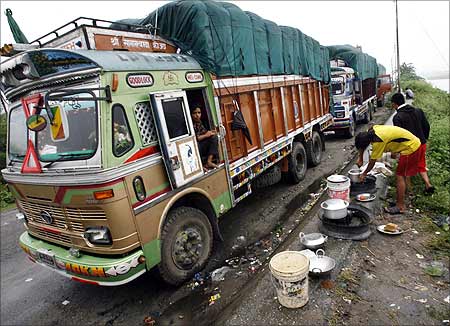
A strong proponent of the GST, Adi Godrej has been saying for five years or more that it will add one per cent to India's gross domestic product (GDP).

The infrastructure spending target for 2020-25 was revised because of additional and amended data provided by central ministries, state governments since the release of the summary NIP Report in December 2019 when it was pegged at Rs 100 trillion.

The most common complaint of financial consumers is cumbersome processes, complicated products, usurious charges, and mis-selling of products, which finally don't deliver what is promised or as expect, notes Debashis Basu.

The idea is to do away with the need for the approval of the Core Group of Secretaries on Divestment for privatisation of companies, especially in non-strategic sectors.

For development finance institution to succeed now, the government must stand like a rock behind it and be patient.

Markets closed in the red on domestic worries.
 © 2026 Rediff.com - Advertise with us - Disclaimer - Privacy Policy - Sitemap - Feedback - About us - Terms of use - Grievances